Services / Daily Protect
Daily Protect
Most of the value is before the fall.
Fall detection is the last line, not the strategy. Daily Protect predicts who is at higher risk today, helps prevent the fall from happening, detects it in real time when it does, and escalates to whoever should actually go.
What Daily Protect covers
The four stages
In the order that actually matters.
Almost every product in this category starts at detection, because detection is the part that demos well. It is also the part that only helps after somebody is already on the floor.
Know who is at higher risk today.
Able Assess, our Alliance partner, gives you an objective clinical baseline in five minutes. Care Daily then keeps that baseline alive, combining it with what the sensors see every night and what the care record already knows, so risk becomes something that moves rather than a number from six months ago.
- Four validated assessments in about five minutes, built on the CDC STEADI framework, and any staff member can run them
- Scored against age and sex matched normative data, so the result is objective rather than an estimate
- Combined with sleep quality, night activity and gait as they change day to day
- Combined with medications and conditions from the care record, since a new prescription can change risk overnight
Change the odds before anything happens.
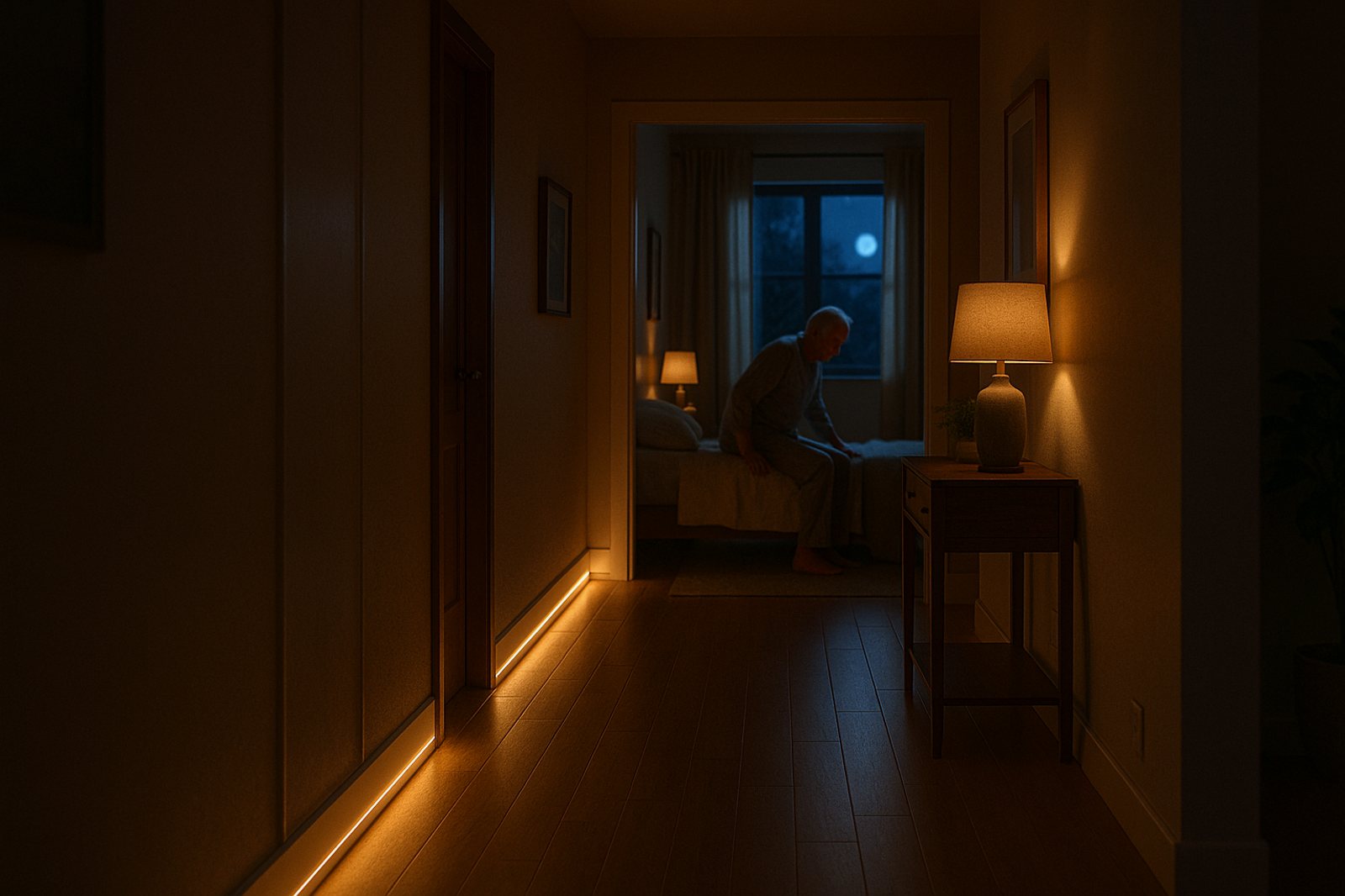
Most falls in a residence happen at night, on the way to the bathroom, in the dark, by somebody who has just woken up. That is a set of conditions you can actually alter.
- Lighting that comes on automatically when someone gets out of bed at night, at a level that guides without waking them fully
- Night-time patterns surfaced while they are still drifting: more bed exits, longer out of bed, more bathroom visits
- Sleep quality treated as a fall-risk factor rather than a comfort issue, because it is one
- The risk list pointed at your therapy, wellness and environment interventions, so effort lands where it changes an outcome
Three ways, because people are different.
When a fall does happen, it needs to be caught however that particular resident lives. No single method covers everyone, so Daily Protect treats all three as first-class.
- Radar fall detection. Contactless, works in the bathroom and the bedroom, and needs nothing from the resident at the moment it matters most
- An mPERS button. Plenty of residents already carry one and trust it. When it is pressed, it enters the same response path as everything else
- Abnormal inactivity. The case nothing else catches: no impact detected, no button pressed, and somebody who has not moved for far longer than they ever do
To the person who should actually go.
The right responder depends on the resident, the event and the hour. Sending everything to everyone is how an alert system gets ignored within a month.
- Staff, when somebody on shift is closest and best placed, with the context already attached rather than a bare alarm
- Family, when the situation calls for reassurance or a decision rather than a clinical response
- The 24/7 emergency call center, when nobody local can respond or the event needs professional escalation immediately
The assessment
Able Assess: four validated tests, one sensor, five minutes.
This is the clinical anchor the whole prediction rests on. It replaces a subjective judgement with a repeatable score, and it is quick enough that it actually gets done.
Run it on intake, run it again when something changes, and let the ambient layer track the same person in between. A baseline from six months ago describes somebody who no longer exists.

On the clinical record
These insights can be held separately.
We hear one concern from nursing leadership more than any other, and it is a fair one: if a system is generating risk signals all day, what happens to them, and who has to answer for what was known and when.
Care Daily's ambient insights do not have to flow into the EHR. They can be kept in their own operational layer, used by your team to decide where to go and what to look at, without becoming part of a clinical chart by default.
Where you do want the connection, it is there: admissions, discharges and transfers keep the roster current, and clinical context sharpens the prediction. That is a decision you make deliberately, per deployment, rather than something that happens to you because a vendor wired it that way.
Why we are explicit about this.
Because the alternative is a system nobody wants to switch on. A nurse who believes every signal becomes a liability will find reasons not to use it, and they will be right to. The point of this is fewer falls, not a longer paper trail.
Talk to us about fall prevention.
Most of the value is before the fall. Tell us about your population and we will show you the risk prediction, the prevention, and the escalation path.
- Predict, prevent, then respond
- Radar or a button, same response
- Held apart from the clinical record
Thank you, that is with us.
Care Daily reads what comes in and routes it to whoever is best placed to answer.