Services / Daily Check-in
Daily Check-in
Know who to check on first. Morning and night.
Every check-in service can eventually tell you who did not get up. Almost none can tell you who has not gone to bed. Care Daily learns both ends of a resident's day, so the question your team answers at 7am and the one nobody is answering at 11pm both get answered.
The half nobody watches
Most check-in products only cover the morning.
That is roughly half the job. A resident who has not gone to bed by midnight, who got up at 2am and never went back, or whose nights have been steadily deteriorating for three weeks, is invisible to a system that only looks for movement after breakfast.
Did they get up?
The familiar question. No movement by the expected hour, no bed exit, still in the residence when they usually are not. This is what the front desk currently answers with a phone call and then a walk down the corridor.
Did they go to bed?
The question nobody is asking. Somebody who is normally asleep by ten and is still up at one has had something happen: pain, confusion, illness, a fall they got up from, or a night that is about to go badly.
Because Care Daily learns each resident's own bedtime and wake time rather than applying a policy to a building, both questions are asked against that person's normal rather than an average. A resident who has always been up at 5:30 is not flagged for being up at 5:30.
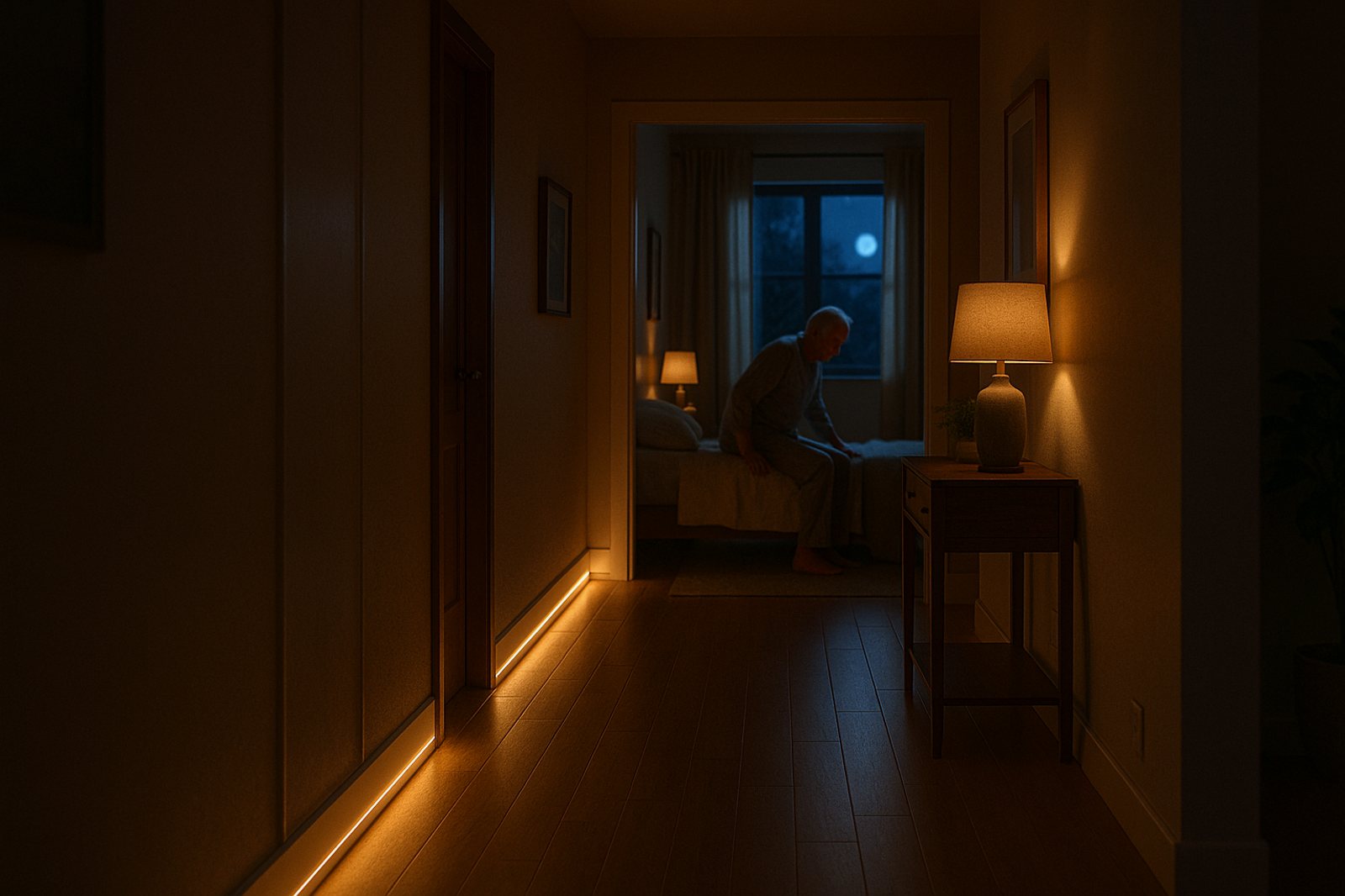
What a night actually contains
Sleep is not one number.
Contactless radar reads the whole night without anything on the body and without a camera in the room. What it produces is not a sleep score, it is a set of specific, actionable observations.
Bedtime and wake time
The two anchors of a day, learned per resident, and the first things to drift when something changes.
Nighttime bathroom visits
How many, how long, and whether that has changed. A rising count is one of the earliest signals of a urinary tract infection, a medication effect, or worsening sleep.
Sleep quality
Restlessness, time to settle, and how broken the night was, tracked against the resident's own history rather than a population norm.
Signs of a sleep disorder
Patterns consistent with disordered breathing or a disrupted sleep architecture, which are worth a clinical conversation and are almost never caught in a community setting.
Out of bed too long
They got up and did not come back. On its own the most operationally useful night signal there is, because the reasons are rarely benign at 3am.
Bed exits
How often, and when. Frequent night exits are a fall-risk signal in their own right and the thing gentle path lighting is there to protect against.
One night, as the system reads it
An illustrative example. Every observation below is measured against this resident's own established pattern, not a building-wide rule.
Why the night matters clinically
Sleep is a modifiable risk factor, not a comfort issue.
The link between how an older adult sleeps and what happens to them next is well established in the literature, which is what makes the night worth instrumenting rather than merely worth asking about.
Inadequate sleep duration has been associated with increased frailty and with higher fall risk on the STEADI screening tool in community-dwelling older adults. Separately, poor sleep health has been shown to predict the onset of a fear of falling, which matters because fear of falling drives people to move less, and moving less makes an actual fall more likely.
That is the loop Daily Check-in is trying to interrupt, and it starts at night.
Tice, Chen, Gurupur, Ng, Fukuda, Lopez, Choi and Thiamwong. Inadequate Sleep Associated with Frailty Development and Fall Risk in Low-Income Older Adults. Innovation in Aging, 2024.
Poor sleep health predicts the onset of a fear of falling among community-dwelling older adults. Sleep Health: Journal of the National Sleep Foundation, December 2023. Abstract
Our own research is on the other side of the same relationship.
Care Daily's peer-reviewed work, funded by the National Institute on Aging, found that in-home assistive technology helped protect the sleep of family caregivers in a randomized controlled trial. Sleep is where we have published, on both sides of the bed.
How it runs
Five steps, and only one of them involves your staff.
Sense
Contactless radar reads bed occupancy, breathing and movement around the clock. Nothing to wear, nothing to charge, no camera, and no action required from the resident.
Learn
Over roughly a week the system establishes that resident's own baseline: when they go to bed, when they wake, what their nights normally look like.
Detect
Each night and each morning, current state is compared against that baseline. Late to bed, late to rise, out of bed too long, and deteriorating sleep are flagged automatically.
Prioritize
Your team gets a ranked morning report and a live view, separated into what needs action now and what is worth knowing.
Act
Staff visit the residents who actually need a visit, arriving with the reason already in hand rather than knocking blind.
The first report lands the morning after installation. Sensors are peel and stick, so a residence takes minutes rather than a trade visit, and the same hardware carries forward if you later move up to Daily Insights or Daily Protect.
Try it first
Buy one and put it in a room tonight.
You do not have to take our word for what the night looks like. Sleep Signal, the bedside radar behind Daily Check-in, is on Amazon as a single unit. No minimum order, no purchase order, no procurement cycle. Put one in a room, watch a week of nights, and decide from there.
Sold as Sleep Signal powered by Care Daily. The same sensing that feeds the morning report, in a single box.
See tomorrow morning's list.
Tell us roughly how many residents you have and we will show you what your morning report would look like, and how much front-desk calling it removes.
- Replaces the manual morning round
- Nothing for residents to remember
- First report the morning after install
Thank you, that is with us.
Care Daily reads what comes in and routes it to whoever is best placed to answer.